The history of the coat of arms in the Ossau Valley
The first coat of arms
The oldest known coat of arms was signed and approved by all the Ossau jurats during the 18th century. However, it is likely that its origins predate this date. Indeed, the Ossau Valley has been a structured and autonomous territory since the early Middle Ages. Possessing its own coat of arms thus enabled the community to assert its identity and uniqueness.
A distinctive inscription and pronunciation
This first coat of arms bears the inscription ‘VAL DE OSAU’, which is read from right to left, though this is not a reproduction error. The spelling ‘OSAU’, with a single ‘S’, is one variant among others. As for the final ‘V’, it is in fact a ‘U’, pronounced ‘W’ in the Béarnais dialect.
To reflect the local pronunciation, the phonetic transcription of the valley’s name could be written as ‘Oüssaü’, pronounced ‘Owsaw’.
The symbolism of the bear
The central element of this coat of arms is a bear wearing a collar, a surprising detail for a wild animal. A symbol of strength and power, the bear here might suggest the idea of a controlled, or even tamed, force, whose qualities the community seeks to embrace.The coat of arms from 1817 to the present day
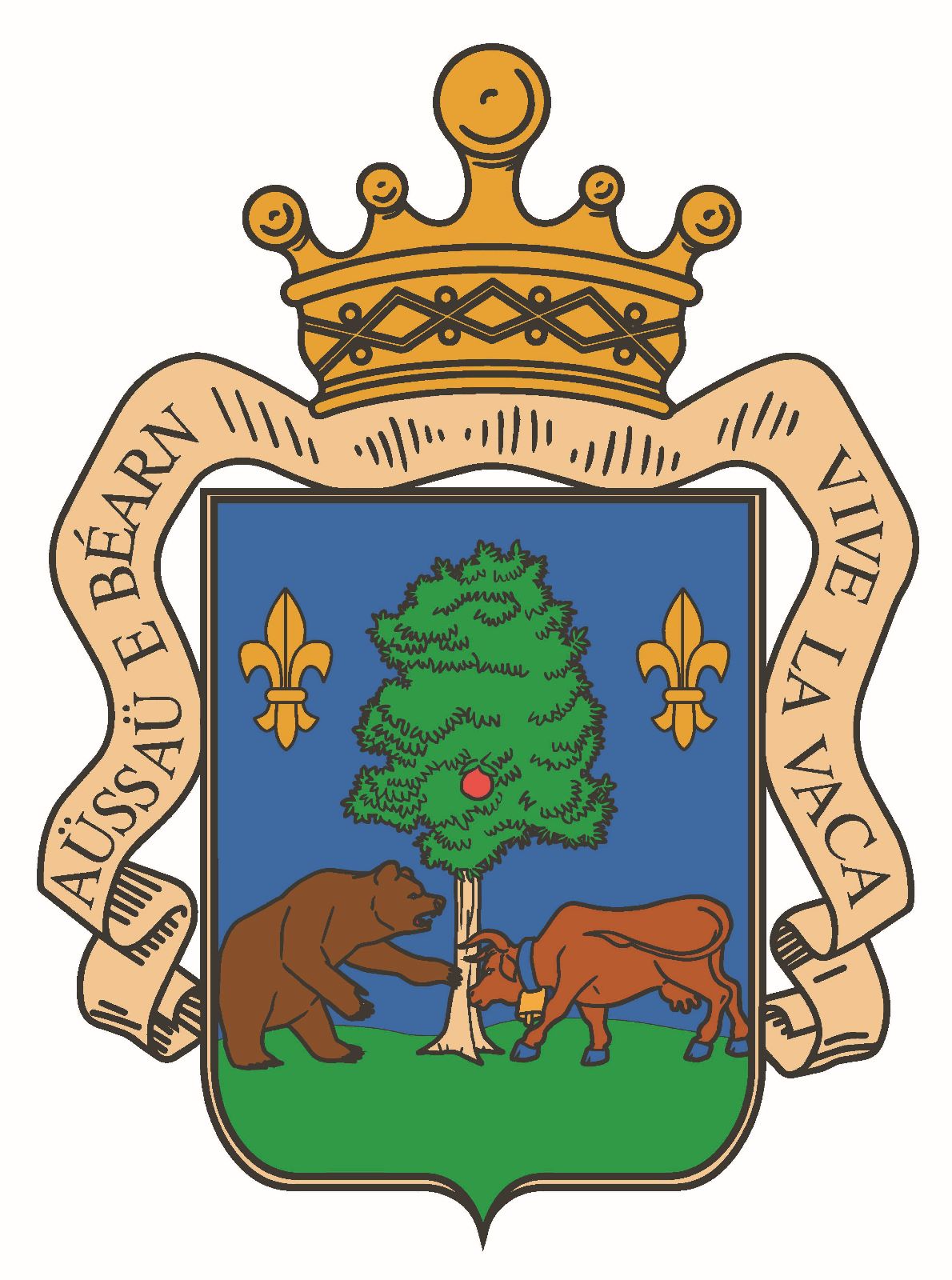
The current coat of arms, meanwhile, dates from 1817.
According to Dr Vastel, its origins are linked to a famous battle between a bear and a cow in the Béost mountains.
This second coat of arms is distinguished by the appearance of fleurs-de-lis, the emblem of the French monarchy, as well as the inscriptions ‘BEARN’ and ‘VIVE LA VACA’, the latter being the battle cry of the people of Béarn.
A symbolic interpretation of the battle
One might therefore assume that the cow embodies Béarn (two cows are depicted on the coat of arms of Béarn), the bear represents the Ossau Valley, and the tree symbolises justice. The battle between the bear and the cow could thus evoke the age-old struggle of the people of Ossau against the Bearnese to preserve their lands, particularly those of Pont-Long.