From the Ice Age to the present day The Ice Age
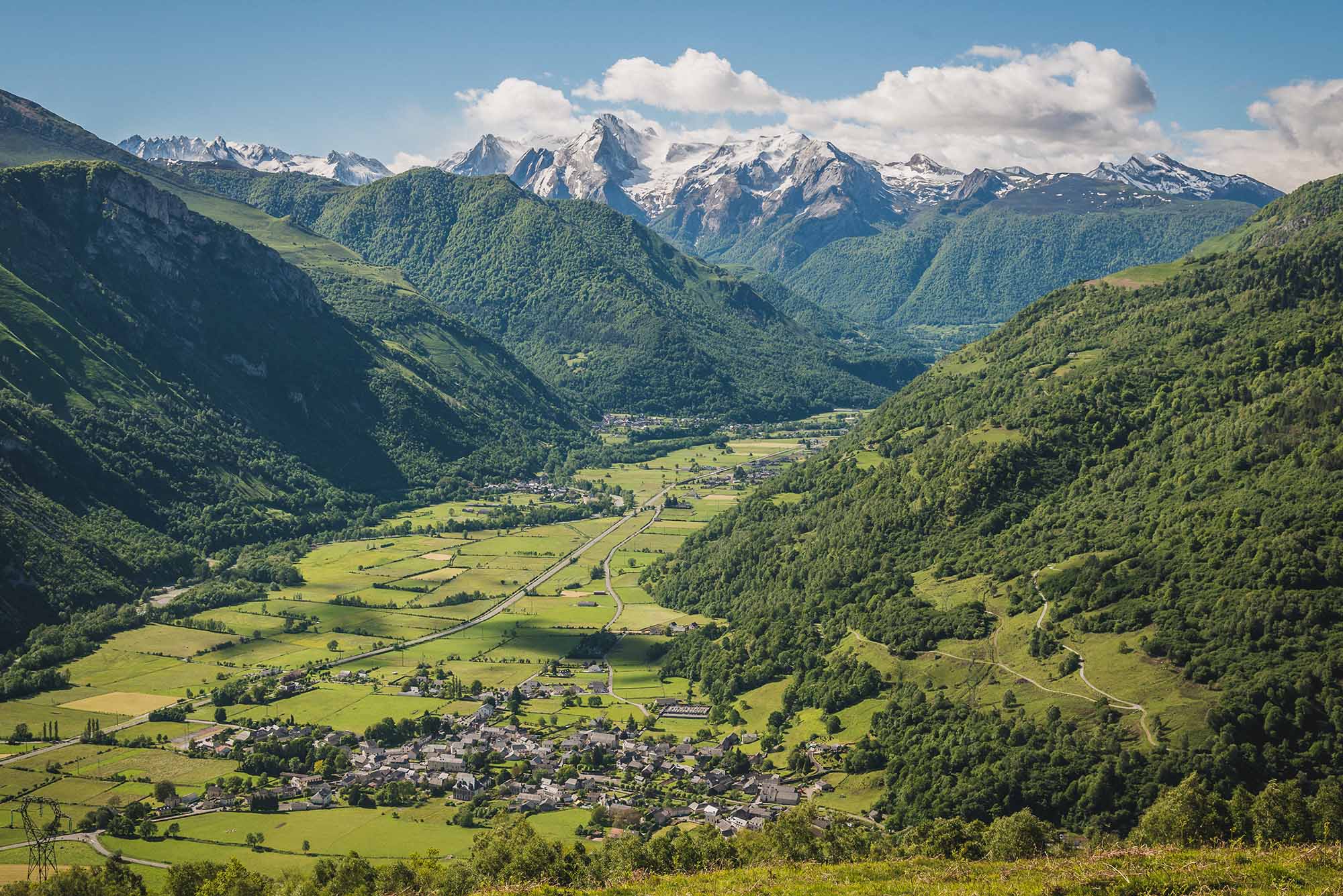
We owe our Ossau Valley to a glacier which, tens of thousands of years ago, covered the Pyrenees.
It was, in fact, a thick layer of ice that carved out the wide valley/plateau that now stretches from Laruns to Arudy.
Palaeolithic/Magdalenian
Numerous remains discovered in the caves around Arudy have enabled us to refine our understanding of this period of prehistory: human presence in the valley is thought to date back to the Late Glacial period (around 17,000 years ago).
It was the warming climate that drove the first hunter-gatherers to migrate towards the mountains.
The dawn of pastoralism / Neolithic period (widespread use of tools)
Gradually, humans transitioned from a hunting-gathering economy to a farming economy.
It was then that the first semi-nomadic pastoralists settled. According to recent palynological studies (studies of pollen and fossils) carried out in Ossau, the beginnings of pastoralism on high-altitude pastures date back more than 7,000 years.
Invasions
As life in the valley gradually took shape, the daily lives of the people of Ossau were forced to adapt with the passage of various peoples: the ‘Iberians’ (who arrived from Asia via North Africa and Spain around 500 BC) and, a century later, the ‘Celts’ (who came from the north and west).
In 60 BC, the Romans, under Caesar’s command, established their administration in OLORON... Rome then moved into the valley, appointing a “magister” (senior official) who had a “vila” built at its heart.
This “vila” (now the village of “BIELLE”: “vila”, “villa”, “biela”) would become the “Capitolium” or “capdulh”, the historic capital of the entire valley.
The Roman Empire’s hold on the territory lasted five centuries but was not limited to the establishment of an administration; it also brought about an economic revolution through the introduction of cereal crops (millet, rye and barley).
Following this long period, Visigothic, Arab and Norman invasions followed one after another. The Normans razed Oloron in 841 and advanced, they too, towards the Ossau Valley.
According to legend, the Ossau resistance was led by the young Lord of Beon, who killed the Norman chieftain in single combat, thus saving the valley!
The chapel of Notre Dame de l’Ayguelade in Bielle was built in memory of this victorious battle.
A Valley Apart
The Ossau Valley gradually took shape as it forged its own identity. In 1221, it was granted its own ‘for’ (a collection of legal texts compiled between the 11th and 15th centuries) by Guillaume de Moncade, Viscount of Béarn.
In the 14th century, the ‘Jurade d’Ossau’, comprising all the valley’s representatives, managed its own system of governance.
It met in the ‘Ségrari’ (a room adjoining the church of Bielle) to ensure the well-being of the inhabitants, the upholding of the valley’s privileges against the seigneurial authority of Béarn, and compliance with pastoral treaties.
At the same time, the inhabitants also governed themselves freely and managed vast tracts of undivided pastureland, both in the mountains and in the lowlands, including the Pont-Long moors north of Pau.
On 15 October 1620, Louis XIII invaded Béarn and entered Pau. Five days later, he issued an edict to ‘bring about the union and incorporation of Béarn and Navarre into the French Crown’.
Béarn thus lost its independence (claimed by Gaston Febus in 1347)... but the people of Ossau did not, for all that, lose their culture and their unique identity.
In order to minimise and stifle the popular uprising, the king ensured that the people of Béarn could retain their ‘rights and privileges’.
Spa tourism and the first tourists
In the 19th century, the Ossau Valley welcomed its first tourists with the development of thermalism, driven by Napoleon III and his wife, Empress Eugénie.
These new, wealthy visitors were responsible for the construction of numerous new facilities in the valley.
It was against this backdrop that the villages of Eaux-Chaudes and Eaux-Bonnes flourished.
The Beginnings of Pyrenean Mountaineering
The mountains towering over these spa resorts attract the most curious and, above all, the most adventurous.
There is so much to explore: passes and peaks to climb... It was with the emergence of local guides (some of whom would go on to become renowned) that mountain tourism began... thereby creating a new economy that marked the start of Pyrenean mountaineering.
Today
Today, tourism remains an integral part of the local economy, alongside hydroelectric power, pastoralism, spa tourism, forestry and other industries...
It was in the 20th century that the Ossau Valley saw the emergence of its two ski resorts: first Gourette, then Artouste.